Looking for a scary movie to watch this Halloween? Well, you could always start with the classics like Psycho, The Shining or maybe Rosemary’s Baby, but beyond that canonical Valhalla lie plenty of great films for any taste on Halloween. I’ve only just started discovering the range of the genre myself, but below you’ll find picks for anyone: three classics many have seen, three other great horror films a bit farther out and even three terrifying non-horror movies, if zombies and slashers aren’t your thing. Happy Halloween!

Doc Legend Albert Maysles at The New School

“I have a point of view, which is not to have a point of view.”
This Monday, documentary students at The New School for Media Studies were treated to a master class from Albert Maysles, whose pioneering documentaries such as Salesman and Grey Gardens helped pave the way for cinéma vérité, or direct cinema. At 85 years old, Maysles hasn’t slowed down, continuing to produce and shoot his unique brand of observational documentaries and develop his uncanny ability to purely capture his subjects’ personalities and humanity. Maysles described his modus operandi as “observing, listening and being patient” in order to establish a direct connection between the subject and the audience. “Pay attention!” and “get close, get close!” he stressed, and from the career-spanning clips of his work which he presented, it’s clear that Maysles has never stopped paying attention. Read more…
Captain America: The First Avenger (2011)
Captain America: The First Avenger / Joe Johnston / 2011 / 
Active Ingredients: Tommy Lee Jones; The ending
Side Effects: Bad jokes; Incorrect tone; Flat action; Hugo Weaving

Dull and stagnant, Captain America strains and ultimately fails to find its own personality. By his nature, the character of Captain America is hooky and old-fashioned, so a successful filmed version calls for a much lighter touch than Johnston can muster. Instead, his film is bulky and awkward. The filmmakers try to inject levity (in the form of some real groaner one-liners, presumably courtesy of cowriter Joss Weadon) rather than build it organically, so instead of some earnest, old-fashioned fun, we get an unimaginative modern approximation of it. Read more…
The Double Life of Véronique (1991)
The Double Life of Véronique / Krzysztof Kieślowski / 1991 / 
Active Ingredients: Irène Jacob; Cinematography; Music
Side Effects: Side plots

The Double Life of Véronique is a spellbinding existential inquiry, a delicate and curious search for meaning and a wise enough film to know that no answers could satisfy as much as the questions themselves. For all its heady mysteries of identity and existence, this film teems with worldly pleasures, foremost among them the rapturous cinematography of Slawomir Idziak. With its warm greens and faded browns, Idziak’s palette is limitlessly expressive, giving each scene (or even shot) its own unique glow. Combined with Kieślowski’s patience and ability to find humor, pathos and humanity in life’s most mundane details, the visual effect of the film is astonishing, warm and inviting, at once familiar and nostalgic, yet brave and unknown. Read more…
Shame (2011)
Shame / Steve McQueen / 2011 / 
Active Ingredients: Powerhouse performance; Visual artistry; Emotional subtlety
Side Effects: A bit overstuffed; Melodrama
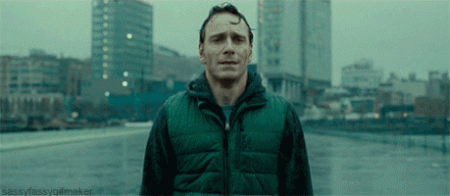
British director Steve McQueen’s first feature was 2008’s gut-wrenching Hunger. He’s taken his time between projects, and it’s clear that he and co-writer Abi Morgan have carefully thought through his followup Shame. The film is about a sex addict, and while McQueen and Morgan have taken the time to truly understand addiction, even more impressive are the many subtle shades of shame and their reverberations across the life of the film’s protagonist. Shame, then, is the perfect title not only as an allusion to the guilt of sex addiction, but to the shame of the addict’s profound loneliness and inability to truly connect with others.
[Shame plays at the New York Film Festival today and Sunday.]
Views from the New York Film Festival
Tuesday was a big day at the New York Film Festival. After 3 screenings and 2 filmmaker Q&As, I even managed to watch Martin Scorsese and company walk the red carpet for the gala premier of his documentary George Harrison: Living in the Material World. Here are some shots featuring David Cronenberg and Michael Fassbender of A Dangerous Method; Joe Berlinger and Bruce Sinofsky of Paradise Lost 3: Purgatory; plus Scorsese, Olivia Harrison and Eric Idle on the red carpet.
-
- Michael Fassbender, star of A Dangerous Method
-
- Michael Fassbender
-

- Fassbender with David Cronenberg, director of A Dangerous Method
-

- David Cronenberg
-

- David Cronenberg
-

- David Cronenberg
-
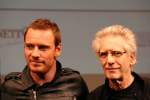
- Michael Fassbender and David Cronenberg
-

- Joe Berlinger, co-director of Paradise Lost 3: Purgatory
-

- Joe Berlinger
-

- Bruce Sinofsky, co-director of Paradise Lost 3: Purgatory
-

- Joe Berlinger and Bruce Sinofsky
-

- ex-Python Eric Idle, who appears in George Harrison
-

- George Harrison’s widow Olivia with director Martin Scorsese
-

- Olivia Harrison and Martin Scorsese
-

- Martin Scorsese
-

- Martin Scorsese
-

- Martin Scorsese
-

- Martin Scorsese
A Dangerous Method (2011)
A Dangerous Method / David Cronenberg / 2011 /
Active Ingredients: Acting; Period details; Use of framing to emphasize theme
Side Effects: Overly talky; Insufficient exploration of psychological theories

[A gala presentation of A Dangerous Method comes to the New York Film Festival today.]
Canadian master David Cronenberg has had a long, varied career, but his last three films mark an intriguing shift. In the 80s, Cronenberg excelled at crafting maddening “body-horror” films, strange tales of transformation and insanity like The Fly and Videodrome. Since 2005’s A History of Violence, however, these external themes have become internalized, couched within thriller frameworks, no less potent but now hiding behind impeccable craft. A Dangerous Method continues this interesting mid-career trend for the director and proves both his technical mastery and the fascinating uniformity of his body of work. Read more…
Carnage (2011)
Carnage / Roman Polanski / 2011 / 
Active Ingredients: Waltz & Reilly; Comedy; Sharp satire
Side Effects: Jodie Foster; Transition scenes

[A gala presentation of Carnage opens the New York Film Festival today.]
Carnage could be seen as novelty in Polanski’s career, one of the only pure comedies. Then again, it fits right in with the rest of his work, using the apartment as a setting to observe presumably well-balanced people reveal their many faults. Though the results are perhaps less horrific in Carnage then, say, Rosemary’s Baby, it’s strengths lie in its sharp characterization of its four leads, all outwardly “nice” people, all inwardly despicable. That may sound tiring, but Polanski and his actors have so much fun eviscerating their characters and revealing their hypocrisy that it’s hard not to join in. Read more…
The Turin Horse (2012)
The Turin Horse / Béla Tarr & Ágnes Hranitzky / 2012 /
Active Ingredients: Chiaroscuro cinematography; Detailed set design; Cogent, consistent philosophy
Side Effects: Loss of focus in some scenes

[The Turin Horse plays at the New York Film Festival on October 9th.]
Hungarian filmmaker Béla Tarr has stated that The Turin Horse will be his final film, and if that’s true, he’s crafted quite a cinematic exit and a film about the struggles, or even the impossibility, of submission. Legend has it that philosopher Friedrich Nietzsche’s mental collapse occurred after he witnessed a coachman beating his horse who refused to budge. He ran to the horse, threw his arms around it and fell mute until his death many years later. Perhaps Nietzsche saw that this horse had it figured out, Tarr slyly posits, and his film imagines the beast of this apocryphal story’s decision to simply give up. What’s the point, anyway? Read more…
The Loneliest Planet Q&A – NYFF
After the press screening of The Loneliest Planet at the New York Festival, program director Richard Peña moderated a Q&A with director Julia Loktev and Hani Furstenberg, who plays the confused and wronged lover of the film. The pair discussed filming in Georgia’s Caucuses mountains, creating the background for the characters in the film and exploring the emotional fallout of the film’s central “incident”. You can read my review of The Loneliest Planet here.


by John DeCarli
VARIABLES

 Film Capsule