On the Bowery (1956)

On the Bowery / Lionel Rogosin / 1956 /

Active Ingredients: Raw, evocative footage; Complex emotional portrait of poverty
Side Effects: Scripted moments undercutting the film’s immediacy

Lionel Rogosin’s independently produced docufiction hybrid On the Bowery is a powerful, largely unfiltered look at the complex issue of postwar poverty and homelessness on “the saddest and maddest street in the world.” Combining beautifully textured and unflinching vérité footage of the titular street with scripted situations involving some of its denizens, Rogosin’s is one of the essential New York films. It may not be 100% “true” documentary footage in the conventional sense, but it’s a potent and vivid document of a very specific time and place. You can catch On the Bowery in a flattering new 35mm print as part of the Boston MFA’s Festival of Film Preservation tomorrow, August 23rd. Read more…

Side By Side (2012)

Side By Side / Christopher Kenneally / 2012 / twostar

Active Ingredients: Important, timely topic; Considers many aspects of production
Side Effects: Lack of experimentation; Cursory view of film history

While the title Side By Side may be a bit of misnomer, producer Keanu Reeves’ documentary on the impact of digital technologies in film production explores an important issue which impacts all of the film world. From photography, to editing, to exhibition and distribution, the introduction of digital media into filmmaking has changed some of the art form’s most basic properties and assumptions, established over 100 years ago. Side By Side opens in limited theatrical release throughout August, and will be available both on VOD and in conjunction with the Boston MFA’s Festival of Preservation, a perfect metaphor for the two extremes the film seeks to address. Read more…

More Notes on “The Clock”

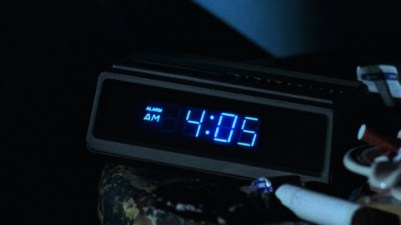
This weekend is your last chance to check out the late night hours of video artist Christian Marclay’s The Clock at Lincoln Center in New York. After catching some more of the film last night (about 10:30pm to 2:15am), I’m still convinced that The Clock is a monumental work and newly impressed at how organically it evolves over the hours. If you missed my first take on it here, The Clock is 24-hour long montage of time-related clips culled from thousands and thousands of films, synchronized with real time as you watch. So shortly after noon, characters from films eat lunch or take breaks from work. At 1 or 2am, however, characters toss and turn in bed haunted by dreams, or sleeplessly wander empty streets. The experience of watching The Clock is much more than its simple premise may suggest, so I’ve left some additional thoughts on the work below. Don’t miss your chance to check it out yourself through this week. Read more…

The Dark Knight Rises (2012)

The Dark Knight Rises / Christopher Nolan / 2012 /

Active Ingredients: Cinematography; Bane
Side Effects: Emotionally and morally muddy; Alfred; Pacing and action

It seems as though Christopher Nolan’s film The Dark Knight Rises, a comic-book action blockbuster like so many others, will forever be associated with the senseless shooting at a Colorado movie theater. “The movie theatre is my home,” Nolan wrote in a reaction to the shooting, “and the idea that someone would violate that innocent and hopeful place in such an unbearably savage way is devastating to me.” In the wake of the tragedy, movie fans and others from around the world have theorized possible connections to Batman or to film and the media in general, but Nolan’s statement reminds us that the shooting was a horrible event, alas, like so many others, that could have happened anywhere at any time. Nolan’s films don’t preach violence, no more than any others, but The Dark Knight Rises will nonetheless unfairly become the symbol of one man’s violence. In a modest effort to divorce a piece of pop entertainment from a much more serious issue, I’d like to close this preamble and consider The Dark Knight Rises as I would any other film. Read more…

Long Take Film: “Bookends”

I recently shot this five-minute short film as an experiment in long take. The long take, for me, is one of the most important tools in a filmmaker’s arsenal and one of film’s most elemental ingredients. I’m particularly interested in how extended shots can imbue locations or objects with a personality, something most directors choose not to spend time on. Take for example, the patience of Michelangelo Antonioni’s “dead time,” or Andrei Tarkovsky’s willingness to linger on a scene.

Of course, this short piece does not live up to those lofty standards, but by moving the characters around a series of simple pans, I hoped to give the setting a life independent of the people inside it. The film also gave me a chance to play around with some ideas I frequently hear as a Media Studies student. As new forms of media are created, do older ones fade away or become absorbed into their successors? Or does it even matter if you’re just trying to finish your research paper and get out of the library?

The Clock (2010)

The Clock / Christian Marclay / 2010 / 

Active Ingredients: Ingenious idea; Scope of project; Rhythms across many films
Side Effects: Simplicity of connections among films

b9d4e59898f53dbc5c10212e1108a1ae_1

Cinema has always been defined by its intimate relation to time, both as a technology and an art. To the first film audiences, cinema seemed able to freeze time and create a true record of duration, something no other medium could achieve. But the technology’s relationship to time is much more complicated. From the curiosity of the early actuality films’ depiction of unbroken time, to the manufacturing of a cinematic time through editing, the experience of watching film has remained a temporal one, and no modern film makes the duration of cinema more apparent than Christian Marclay’s monumental The Clock.

The result of thousands of short film clips and years of editing, The Clock is a 24-hour long installation piece exploring film’s connection with time and the collective hours we’ve spent seduced by images in the dark. The idea is very simple: whatever time it is in real life as you watch the film, corresponds directly to the images and actions on screen. If it’s noon, we see clips featuring clocks or watches that show 12:00, or characters referencing that time of day. For every minute of the day, fragments of films from all over the world and across the breadth of film history represent the actual time, synchronized perfectly with the time of the spectator. Read more…

Interview with the co-directors of “Ultimate Christian Wrestling”

Interview with Jae-Ho Chang and Tara Autovino, co-directors of Ultimate Christian Wrestling
World Premiere this weekend at Korean American Film Festival New York


One wrestler picks up another by his spandex shorts, muscles bulging as he tosses him across the ring. Another dives from the top of the post. Kicks and clotheslines are exchanged until slowly the wrestlers realize their victim isn’t the enemy they thought but a long-haired man in a white robe. The man is Jesus, come to offer salvation, and the event is not WWF but Ultimate Christian Wrestling, a one-of-a-kind combination of religion and professional wrestling. In Ultimate Christian Wrestling, directors Jae-Ho Chang and Tara Autovino follow the group’s leader Rob Adonis in his attempt to gain recognition from the mainstream Southern Baptists. Meanwhile, fellow wrestlers Billy Jack and Justin struggle with financial problems, divorce and finding a calling in life. I sat down with Chang and Autovino for The Christian Science Monitor to discuss the challenge of portraying these universal stories and the real, relatable characters that emerge in this very strange setting. Read more…

Moonrise Kingdom (2012)

Moonrise Kingdom / Wes Anderson / 2012 /

Active Ingredients: Details of the film’s universe; Tenderness; Adventure
Side Effects: Forced climax; Loss of focus on central characters

Much of the storybook visual design and convivial humor of Moonrise Kingdom will feel familiar to fans of director Wes Anderson. While his tender, warmhearted tale of young love and misunderstood eccentrics may not be a stretch for Anderson, there’s enough genuinely new and resoundingly satisfying about Moonrise Kingdom to make it Anderson’s best live-action film in a decade. Read more…

Andrei Tarkovsky and Digital Filmmaking

Film Capsule has recently been contributing to Indiewire’s weekly survey of film critics, which poses some great questions to film writers around the Internet. This week’s Criticwire Survey was a particularly tricky one: “What late filmmaker would most benefit from being alive today and having access to modern filmmaking technology?” My answer was Andrei Tarkovsky, but although digital technology may have afforded the great director tempting new possibilities, how would he have reacted to these change in film art? Read more…