Interview with Award-winning Screenwriter Andrew Lanham

ampas25thannualdongeenichollfellowshipsgfpjomcn-wcl

Lanham, second from left

Before October, Bangor native Andrew Lanham was, like many young screenwriters, studying writing in graduate school, diligently working on his craft and hoping to one day see his scripts reach the big screen. Then, with one phone call from the Academy of Motion Pictures Arts and Sciences, his career took off. Lanham’s script, The Jumper of Maine, was chosen as a winner of the prestigious Nicholl Fellowship for unproduced screenwriters. Since then, the script has gone on to win two more awards at the Austin Film Festival and was selected to be performed as a staged reading by the Texas cultural arts center Ballroom Marfa. A producer has even signed on to help turn the script into a film. “Winning the awards has done nothing less than start my career,” Lanham says. Yet while a lot has changed for the writer, he remains focused on his work and on nurturing his love for the craft of screenwriting.

Read the interview.>>

Super (2011)

Super / James Gunn / 2011 / threestar

Active Ingredients: Strong characters; Acting; Edginess
Side Effects: Comic book elements; Narration

“Is the violence in this film funny to you,” one perturbed viewer asked director James Gunn at a screening of Super at Cambridge, MA’s Brattle Theater. “Uh, some of it,” was his dismissive reply. The morality of the extreme violence in Gunn’s darkly comic real-life superhero film is sure to drive its critical discussion (and repulse many viewers), but it’s not a conversation Gunn is interested in. Blood is spilled very cavalierly in Super, and while it may be a missed opportunity, little is made of its consequences. Gunn is clearly more interested in satisfying the audience’s bloodlust than condemning it, and when it’s done with as much wit and fun as this, that’s alright with me. Read more…

Uncle Boonmee Who Can Recall His Past Lives (2011)

Uncle Boonmee Who Can Recall His Past Lives / Apichatpong Weerasethakul / 2011 / fivestar

Active Ingredients: Graceful style; Imagery; Sound; Political and spiritual themes
Side Effects: Little cohesion among its different parts

Uncle Boonmee Who Can Recall His Past Lives, like all of Thai auteur Apichatpong Weerasethakul’s work, is a strange and hypnotic experience, sure to captivate some viewers while alienating those expecting standard narrative storytelling. His films are better felt than understood, and while surrendering to their lyricism can be difficult for westerners weaned on the wares of Hollywood, it will prove rewarding to adventurous viewers.

Apcihatpong’s films, and Uncle Boonmee particularly, come the closest to a cinematic equivalent of Magical Realist literature. Like Hayao Miyazaki, Apichatpong creates worlds that are recognizably our own, yet shared with ghosts, spirits and magic, lingering traces of the past that buzz all around us like jungle mosquitoes. Read more…

A Bucket of Blood (1959)

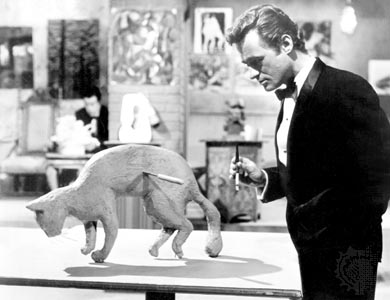
A Bucket of Blood / Roger Corman / 1959 / fourstar

Active Ingredients: Good premise; Beat satire; Simple direction
Side Effects: Dick Miller; Few surprises

Good horror doesn’t need monsters, gore or sheer terror. A good, creepy premise, simple direction and creative storytelling will do just fine. Depending on your definition, Roger Corman’s A Bucket of Blood may or may not truly be a horror film, but its certainly a lean, effective bit of genre filmmaking. Read more…

Sunrise: A Song of Two Humans (1927)

Sunrise: A Song of Two Humans / F.W. Murnau / 1927 / fivestar

Active Ingredients: Emotional story; Exciting visual style; Janet Gaynor
Side Effects: Chase scene

F.W. Murnau’s great romantic masterpiece Sunrise exhibits a humble and gentle understanding of the agony and ecstasy of life rare for a film of its era or any era. The film achieves its goal of creating a moving and unflinching parable of life and uses an equally beautiful and ambitious visual style to tell its story. In fact, the film won an Oscar for Most Unique and Artistic Production, an award given only once, at the Academy’s first ceremony.

Murnau, known for the ornate visual style of his German Expressionist works such as Nosferatu, brought his artistic eye to Hollywood for Sunrise. Through startlingly-advanced and fluid camera movements and evocative superimposed images, he creates a lyrical, graceful world that’s the equal of the film’s allegorical scope.

Read more…

Indie Interview: Joy and the Apocalypse

Filmmaking duo Dan Black and Ryan Convery took a crazy idea and $7,000 and turned it into Joy and the Apocalypse, a Boston-based independent film that’s now hit both local television and the big screen.

title

“The sky is falling,” exclaims one character in the new film Joy and the Apocalypse, a drama set on the eve of the apocalypse. As any independent filmmaker will tell you, making a low-budget film isn’t easy. It takes resources, connections, lots of skill and even a bit of luck. Sometimes it may even be the filmmaker claiming that the sky is falling. But with an eye for screenwriting, a love of planning and a knack for business, directors Dan Black and Ryan Convery managed to get their film off the ground and even on the air at MyTV New England. I spoke with the directors after the film’s broadcast debut and theatrical premiere, for a piece at NewEnglandFilm.com.

Read the interview. >>

Unknown (2011)

Unknown / Jaume Collet-Serra / 2011 / onestar

Active Ingredients: Bruno Ganz; Old-school premise
Side Effects: Acting; Boring development; Bland twist

I don’t demand that action movies make sense. No, a good mindless action flick can satisfy like no other kind of film. I do, however, demand that my mindless entertainment be entertaining. Unknown commits the cardinal sin of action: weaving a muddled web of limp plotting and failing to register a pulse. Unlike Liam Neeson’s previous thriller Taken, which had fun following its badass hero, Unknown gives us a protagonist that’s barely there. The very confused lead wonders around ineffectually and rather than do anything interesting with the character’s mystery, the film leaves him as an empty hole. Read more…

Zardoz (1974)

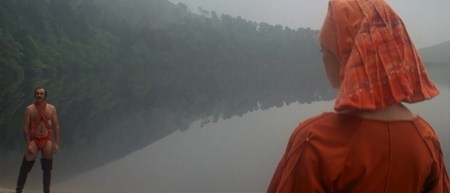
Zardoz / John Boorman / 1974 / twostar

Active Ingredients: Weirdness and creativity; Funny costumes
Side Effects: Dense mythology and philosophy; Tedious

Unapologetically strange and risible, John Boorman’s cult classic Zardoz is, at least, a very different film-watching experience; if you think you’ve seen it all, this is one to seek out. Despite its amusingly dated production design and philosophy, and its tripped-out visual flourishes, Zardoz boils down to a rather reductive and facile rehash of familiar cautionary tales. Read more…

Sherman’s March: A Mediation to the Possibility of Romantic Love in the South During an Era of Nuclear Weapons Proliferation (1986)

Sherman’s March / Ross McElwee / 1986 / fivestar

Active Ingredients: Self-deprecating humor; Honesty; Fascinating form
Side Effects: Slightly too long

More of a personal essay than a standard documentary, Ross McElwee’s Sherman’s March is a unique film, but its pleasures are much simpler than dry formal experimentation. It’s a film about love, heartbreak and lethargy—and, yes, Sherman’s March—but it’s also discernibly a comedy. The film opens with a map graphic and a brief overview of the Civil War general’s destructive path through the south, quickly followed by a long shot of the director, recently dumped, pacing around his apartment. You see, McElwee set out to document the lingering effects of Sherman’s March on south society, but he doesn’t get much further than five minutes into the film. From then on it becomes about the depressed director’s struggle to find love and a direction in life. He halfheartedly follows Sherman’s trail, but he’s more interested in the women he encounters than the monuments he visits. Over the course of the film, a bevy of southern women flit in and out of his life, some quirky, some crazy, all of them interesting.

Read more…

Boston’s Cinematic Persona

My article on the image of Boston in film from NewEnglandFilm.com

Since 2006, a generous governmental tax credit has lured many film crews into Boston, and the recent crop of productions has helped established it as a true film city. With the release of no fewer than 18 major movies and TV shows shot in the city, 2010 was Boston’s most prolific year yet. People Magazine even named it the year’s Best Supporting City. The success of films like The Social Network, The Town and The Fighter, boasting strong box office receipts, critical acclaim and an impressive 16 combined Oscar nominations, attests to the city’s appeal, but what about Boston’s image has captivated audiences?

Read the article. >>>